Last updated September 2026.
A modern phone system for an insurance company must do more than make and receive calls.
It should give IT one interface from which to manage the users, numbers, routing, policies, carriers and connected services behind every conversation.
That matters because voice remains critical when a policyholder reports an accident, questions a claim, discusses a complex commercial risk or requests urgent assistance.
Yet the technology supporting those conversations is often fragmented.
Microsoft Teams may sit alongside a legacy PBX, contact centre, carrier portals, recording tools, spreadsheets and, increasingly, a separate Voice AI platform.
Acquisitions can add more Microsoft tenants, suppliers and number ranges before the organisation is ready to consolidate them.
Modern insurance voice environments are rarely simple—and they do not have to be. Cloud platforms, legacy PBXs, SIP devices, contact centres and Voice AI can run side by side under a common control layer.
This is the role of voice orchestration. It allows an insurer or broker to manage carriers, services, phone numbers and users through one platform while modernising at its own pace.
IT can replace what needs to change, keep what still works and maintain consistent number, routing and governance controls underneath.
In this guide
- Common insurance phone-system problems
- What a modern system should enable
- Security, compliance and reporting
- Requirements by organisation size
- Mergers, acquisitions and multiple tenants
- How we have helped insurance companies
- How Callroute helps
Common phone-system problems
Insurance IT teams rarely modernise because calling has stopped completely. More often, several smaller problems accumulate:
- A legacy phone system still carries calls but cannot support Microsoft Teams, modern routing, useful reporting or hybrid working without additional tools and workarounds.
- Multiple carriers, Microsoft Teams, PBXs, contact centres and recording tools are managed through separate portals and processes.
- Number assignment, policy changes and queue membership rely on spreadsheets, PowerShell or a few specialists.
- Remote employees need forwarding or exceptions to remain available to customers.
- Call recording and routing policies are applied inconsistently.
- IT cannot easily see which numbers are assigned, unused or tied to an important service.
- Reporting is split across platforms, making it hard to follow demand and call outcomes.
- Voice AI introduces another supplier, dashboard and failure path.
- In some cases, acquired businesses or mergers bring additional tenants, contracts and local administrators.
Multiple carriers can be particularly difficult to govern. Insurance groups may use different providers by country, business unit or acquired company, leaving IT with separate contracts, number inventories, routing controls, reporting formats and support processes. Consolidating every carrier may be neither practical nor desirable, but managing each relationship in isolation makes it harder to maintain a complete view of the voice estate.
Legacy telephony is often the starting point. The system may remain reliable for basic calling, but becomes increasingly difficult to integrate with Microsoft Teams, support remote employees or adapt when the business changes. IT then adds forwarding, separate applications and manual processes around it. The issue is not simply that the technology is old; it is that maintaining it prevents the organisation from simplifying the wider voice environment.
The result is operational drag: routine changes take longer, controls are harder to evidence and the estate becomes dependent on individual knowledge. The answer is not necessarily a disruptive replacement of every working service. It is a controlled transition to one operating model with clear ownership, common policies and central visibility.
What should a modern insurance phone system enable?
Keep remote employees in the same call flows
Hybrid work should not require a separate communications model. A remote claims handler should be able to receive the same queue calls as an office colleague through Teams. Their business identity, queue permissions, routing, recording treatment and reporting should remain consistent.
IT still needs standards for devices, connectivity and support outside the corporate network. But users should not need personal-number forwarding or an additional softphone simply because their location changes.
Use the right calling model for each department
Claims, assistance and customer-service teams may need inbound call queues. Underwriters and account executives may need direct numbers. Some back-office employees only need to make occasional outbound calls using an approved company identity.
Microsoft Teams Shared Calling allows multiple Teams users to make outbound calls using a single shared number. It can suit departments such as policy administration, finance, HR or temporary project teams that do not require an individual number for every user. It is different from a call queue, which distributes inbound calls to available agents. IT should design the callback route, emergency calling, recording and reporting around both.
Make routing responsive and resilient
Insurance demand can change quickly. A storm, travel disruption or service outage may require extra queue capacity, extended hours, revised announcements or overflow to another team. Critical numbers also need a tested destination when the normal service is unavailable.
Routing should therefore be treated as part of operational resilience. IT should map important numbers to the business services they support and document the owner, operating hours, overflow, failure route and test schedule. The FCA’s operational resilience requirements provide relevant context for regulated UK firms.
Treat phone numbers as governed assets
Numbers often outlive the people and systems to which they were assigned. A useful inventory should show each number’s status, owner, carrier, location, destination and history. It should also support grouping by brand, country or function and connect with joiner, mover and leaver processes.
This reduces the risk of paying for unused numbers, reassigning a number too soon or changing an important service without its recording and fallback requirements. Centralised phone number management keeps numbering visible and independent from individual carriers, platforms and short-term architectural decisions. Callroute can also provide central visibility and management for Microsoft Calling Plan, Operator Connect and Direct Routing numbers, even when Callroute is not in the call path.
Add Voice AI without adding another management silo
Voice AI may reduce call-handling costs, but it can create a new problem for IT: another platform to integrate, secure, monitor and support.
A standalone service can add another supplier, portal, data flow and reporting source. It may also introduce separate phone numbers, routing rules, recording behaviour and failure procedures. The organisation risks removing work from one team while adding cost and complexity to the technology estate.
Fragmented reporting then makes the savings difficult to prove. IT needs visibility of which calls the AI completes, transfers, loses or sends to fallback—as well as control over the associated data, access and human routes.
Our advice is simple: treat Voice AI as a destination within the existing voice environment, not as a separate phone system. Keep control of the number, route and fallback so the AI service can be changed without rebuilding the customer entry point.
Voice AI should remain one governed destination within the wider voice estate—not another disconnected phone system for IT to manage.
Callroute can connect phone numbers to Voice AI services while retaining control of the surrounding numbers, routes and failover alongside Teams and other services. This helps IT introduce automation without surrendering central visibility or duplicating the complete telephony-management layer.
Security, compliance, auditability and reporting
Modernisation should improve control, not merely convenience. Administrator access should use approved authentication and least-privilege roles. A change history should help answer who assigned a number, altered a route, applied a policy or accessed a service.
Security reviews must cover the whole communications chain: Microsoft Teams, carriers, recording providers, contact centres, Voice AI, storage, APIs and support access. IT should document what customer and employee data each service processes, where it is stored, how it is protected and how it can be retrieved or deleted. The ICO’s AI and data-protection guidance is useful when voice content or transcripts reach AI services.
Call recording requires particular precision. Not every call necessarily needs recording, and standard Teams recording is not the same as policy-based compliance recording. IT, legal and compliance teams should establish which interactions are covered, how people are notified, where recordings are stored, retention periods, access rights and the response to a recording failure. Microsoft explains its model in its Teams compliance-recording guidance.
Delegated administration can then reduce central workload without giving every local administrator tenant-wide access. Group IT can set standards while regional teams, acquired businesses or an MSP manage only approved users and numbers. Changes should remain visible centrally.
Reporting should be designed around decisions. Operations may need demand and call-outcome patterns; IT needs diagnostics; finance needs usage and cost; number managers need capacity and allocation. Larger groups may need reporting by brand, region or acquired company.
When Callroute carries the calls—for example through Direct Routing or as the carrier—the portal provides call volumes, usage patterns, routing activity, costs and call diagnostics. IT should still confirm which additional insight comes from Microsoft, a contact centre or an AI platform and whether the combined data answers the organisation’s actual questions.
Phone-system requirements by insurance organisation size
Scale is not just a user count. It includes offices, brands, countries, queues, numbers, carriers, administrators and Microsoft tenants.
Small and specialist brokers
A small broker may have no dedicated telephony administrator. It needs dependable Microsoft Teams integration, simple routing, clear number allocation and reporting an IT generalist or MSP can use. The priority is removing specialist effort without losing control.
Growing regional brokers and insurers
A regional firm may have several offices and functional queues. It needs repeatable provisioning, common policies, delegated administration and phased migration. Standardisation becomes important as user moves and service changes increase.
Large national insurers and broker groups
A large organisation may support thousands of employees, many service queues and acquired brands. It needs automated provisioning, reliable inventories, policy templates, controlled delegation and reporting by function or business. Routine changes should not depend on a small central team.
Global insurers, brokers and reinsurers
Global organisations add regional carriers, regulations and operating models. They need central visibility with controlled local variation. Modernisation should not force every country onto one carrier or tenant; it should prevent each region from becoming an administrative island.
Managing telephony through mergers and acquisitions
An acquisition can add a Microsoft tenant, carrier contracts, number ranges, queues and administrators overnight. Moving everything immediately may be impractical because of legal structures, application dependencies, brands or regional migration plans.
Centralised management is different from tenant consolidation. The former gives IT visibility and control across environments; the latter moves users and services into one Microsoft tenant. An acquired broker can remain in its existing tenant while group IT applies common provisioning, number governance and delegated access.
A common control layer can deliver value before, and sometimes without, full tenant consolidation.
Orto multi-tenant management brings users, policies, numbers and licences from multiple Microsoft 365 tenants into one interface. This can give an acquisitive insurance group operational control while the long-term architecture is still being decided.
A quick insurance telephony checklist for IT teams
Before selecting or changing an insurance phone system, ask:
- Can we change carriers or connected services without losing control of our numbers?
- Can we manage users, numbers, routing and policies from one interface?
- Can remote employees join the same queues under the same controls as office teams?
- Do we know who owns every important number and where it routes?
- Are recording policies, retention and access clearly defined?
- Can local administrators make approved changes without receiving tenant-wide access?
- Can reporting show demand, answer rates, transfers, abandonment and fallback?
- Can we manage acquired Microsoft tenants before deciding whether to consolidate them?
- Can Voice AI be connected without creating a separate telephony silo?
- Are human escalation and service-failure routes documented and tested?
We recommend answering these questions against the current estate before comparing products. That exposes the operational problems the project needs to solve and creates a baseline against which improvements and savings can be measured.
How we have helped insurance companies in practice
The challenges covered in this guide are ones we have already helped insurance organisations address.
Limoss implemented Callroute to replace a legacy telephony system that had “a number of limitations and no integration with MS Teams”. Its five-star review describes the practical difference:
“The Teams integration has been seamless, the reporting is robust, and the portal is easy to use.”
“From an operational perspective, we now have far better control over call routing and number allocation.”
Limoss also highlighted the platform’s “clear visibility of call volumes, patterns, and performance metrics” and described Callroute as “a reliable and effective telephony solution”.
A second verified insurance customer, which has used Callroute for more than two years, shared a similar experience:
“It removes a lot of the complexity around voice routing and number management, which makes day-to-day operations much smoother.”
The reviewer also said Callroute “seamlessly integrates with existing communication platforms” and described its core functionality as dependable and operationally valuable.
Together, their experiences show how voice orchestration can help insurance IT teams integrate calling with Microsoft Teams, simplify routine management and gain clearer control over numbers and routing.
View the full customer testimonials on Capterra.
How Callroute helps insurance IT teams
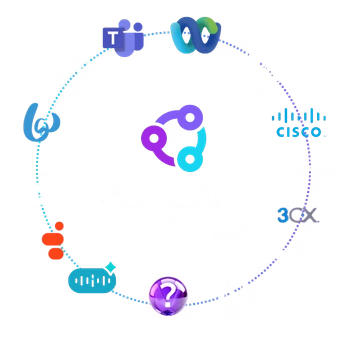
Callroute is a global SaaS platform built to be the control layer for modern business voice. It connects and manages Microsoft Teams, Webex, carriers, phone numbers, contact centres, Voice AI, PBXs and SIP devices through one platform.
Enhanced by Orto, IT teams can also manage Microsoft Teams users, numbers, policies and licences, automate provisioning, apply delegated access and support multiple tenants—even where Callroute is not in the call path.
For a smaller broker, that can simplify the move from a legacy phone system to Teams.
For a regional insurer, it can create consistent management across offices and hybrid teams.
For a national or global group, it can provide one control model across acquired businesses, regional administrators and large number estates.
This can support cost reduction by retiring legacy infrastructure, identifying unused numbers, reducing manual work and avoiding unnecessary individual numbers through Shared Calling. It can also strengthen governance by improving visibility of roles, changes, routing and number history. Results will depend on the existing estate, so savings and control improvements should be measured against a documented baseline.
Callroute does not replace an insurer’s compliance or resilience programme. It helps IT implement that programme’s communications decisions while keeping numbers and routing separate from individual services. That makes it easier to introduce or replace carriers, contact centres and Voice AI over time.
Ready to simplify your insurance voice estate?
If your IT team is managing Microsoft Teams alongside legacy telephony, multiple carriers, acquired tenants or a new Voice AI service, Callroute can help bring those moving parts into one management interface.
Book a Callroute demonstration to review your current users, numbers, call routes, tenants and connected services—and identify practical opportunities to simplify administration, strengthen control and reduce avoidable costs.
Not ready for a demonstration? Explore Callroute for Microsoft Teams Phone to see how centralised voice management works.