When your organization moved to Microsoft Teams for voice, emergency calling probably made it onto the deployment checklist. Addresses were assigned. Policies were configured. The box was checked.
That is where most enterprise Teams deployments stop.
And it is where the risk starts.
Emergency calling is not a one-time configuration. It is an ongoing operational responsibility, one that carries legal weight, regulatory scrutiny, and in a genuine emergency, life-safety consequences. For large enterprises with hundreds or thousands of Teams users spread across multiple sites, keeping that configuration accurate over time is harder than it looks. Network changes, office moves, hybrid workforces, and carrier migrations all create opportunities for location data to drift silently out of sync.
This guide covers what enterprise IT teams need to understand: the compliance obligations that apply to your Teams deployment, why large organizations are disproportionately exposed to getting this wrong, and what it takes to stay on top of it. We also cover Callroute’s new Enhanced Emergency Services Information feature, which gives administrators direct visibility into the location data that determines whether your emergency calling configuration is actually working.
Why Emergency Calling Is a Higher-Stakes Problem Than Most IT Teams Realize
The stakes are straightforward. If a member of your team dials 911 from a Teams client and emergency services are dispatched to the wrong floor, the wrong building, or, worse, the wrong address entirely, the consequences are not a service ticket. They are a delayed emergency response.
Emergency calling non-compliance also carries direct financial exposure. In the US, FCC enforcement actions can result in significant financial penalties. In the UK, regulators have issued penalties totaling over $1 million across multiple enforcement actions for emergency calling failures. In one case, a fine exceeded $880,000 after business users lost access to emergency services for eleven days, not because of a system failure, but because a routine update was never tested for its impact on emergency calling. In a separate case, an organization was fined approximately $155,000 after its users had been calling emergency services with inaccurate or absent location data for over two years, affecting 948 calls. Nobody had tested it.
Both organizations had configured their systems. Neither had maintained them.
For an enterprise IT team managing Teams voice at scale, those cases reflect a failure mode that is easy to replicate. The initial setup works. Then the network changes, a site is added, a switch is replaced, and nobody updates the location data. The system continues to route calls. The errors are silent. Until they are not.
What the Regulations Actually Require
Across the US, UK, and EU, emergency calling obligations share a common thread: it is not enough for a call to connect. The right location must reach the right emergency service at the right time. The specific rules differ by jurisdiction, but the operational implication is the same.
United States: Kari’s Law and RAY BAUM’s Act
Two federal laws govern emergency calling for multi-line telephone systems (MLTS), the category that includes enterprise cloud voice platforms like Microsoft Teams. Kari’s Law requires that any MLTS allow users to dial 911 directly without a prefix or access code, and that the system automatically notify a central location, such as a security desk, whenever a 911 call is placed. The FCC has confirmed these rules apply explicitly to IP-based and cloud-based systems.
RAY BAUM’s Act goes further, requiring that a ‘dispatchable location’ be transmitted with every 911 call, defined as the caller’s validated street address plus any additional information necessary to physically locate them: floor, suite, room. A headquarters address is not dispatchable location for a caller on the fourteenth floor. Both laws are fully in force, and FCC enforcement actions can result in significant financial penalties. The FCC’s MLTS compliance page is the authoritative reference.
United Kingdom: Ofcom General Conditions
In the UK, emergency calling obligations sit within Ofcom’s General Conditions of Entitlement, specifically GC A3, which applies to regulated communications providers rather than enterprise IT teams directly. However, where an enterprise manages its own Direct Routing deployment, the configuration decisions that determine whether those obligations are met sit operationally with the IT team. GC A3.2 requires uninterrupted access to emergency organisations. GC A3.5 requires accurate and reliable caller location information to be available at the time a 999 or 112 call is answered, to the extent technically feasible.
Ofcom’s active compliance programme into emergency call access, announced in 2025, confirmed the regulator is now investigating whether providers have adequate measures in place. The enforcement record shows Ofcom is prepared to impose significant financial penalties where those measures fall short.
European Union: Article 109 of the EECC
Across the EU, Article 109 of the European Electronic Communications Code requires providers of number-based communications services to ensure free access to the single European emergency number 112 and to transmit caller location information with every emergency call. As in the UK, these obligations sit with providers rather than enterprises directly, but the operational responsibility for correct configuration flows through to how enterprises deploy and manage their systems. EU Delegated Regulation 2023/444 introduced accuracy and reliability criteria for caller location data. Critically, the EECC is transposed differently in each Member State. An enterprise running Teams across the US and Europe cannot assume a single configuration meets every jurisdiction.
Where Enterprise Teams Deployments Go Wrong
Research consistently shows the scale of the gap. Metrigy’s Employee Engagement Optimization study of 400 organizations found that only 64% of US companies believed they were compliant with both Kari’s Law and RAY BAUM’s Act, with minimal improvement year over year. That means more than a third of organizations have a compliance gap, and many do not know it. That is consistent with the enforcement record: organizations configure their systems and move on, not because they are negligent, but because nothing signals that something has gone wrong. Emergency location errors are silent until an emergency exposes them.
For large enterprises, three structural problems drive that drift.
The first is scale. An organization with 1,500 users across ten sites may have hundreds of entries in the Teams Location Information Server (LIS), the database that maps network identifiers like subnets and Wi-Fi access points to physical locations. When a 911 call is placed, Teams queries the LIS to determine where the caller is and routes accordingly. Every network change, whether a new floor, a replaced switch, or a site consolidation, has the potential to invalidate previously accurate LIS entries. There is no automatic notification when that happens.
The second is validation gaps. Microsoft validates emergency addresses against its mapping database when they are first entered. But validation status is not prominently surfaced across large location lists in the Teams Admin Center. An address that fails validation may still route calls, just without the accuracy guarantee that validation provides. An IT team managing hundreds of locations has no easy way to identify which entries have a problem without manual inspection or scripting.
The third is the ELIN dependency. For Direct Routing deployments using Session Border Controller (SBC) based routing, each location carries an Emergency Location Identification Number (ELIN), a dedicated phone number that identifies the physical location to the PSAP. The ELIN value in Teams must exactly match the record in the SBC’s ELIN application. A mismatch caused by a format difference, a stale import, or an update applied in Teams but not propagated to the SBC means the PSAP receives a number it cannot resolve. The call connects. The location does not. This is precisely the kind of silent failure that Microsoft’s Direct Routing documentation flags, and the kind that goes undetected for years when there are no monitoring procedures in place.
What Staying Compliant Actually Looks Like
Compliance with emergency calling regulations is not a deployment milestone. It is an operational discipline. The organizations that get this right treat emergency location management as part of routine voice administration, not a separate annual audit.
In practice, that means maintaining the LIS in step with network changes, regularly verifying that address validation is confirmed across all locations, ensuring ELIN values are consistent between Teams and the SBC, and having enough visibility into location data to catch problems before they affect a call. For enterprises managing Teams voice at scale, that visibility has historically required either manual inspection or PowerShell scripting, neither of which integrates naturally into day-to-day voice management.
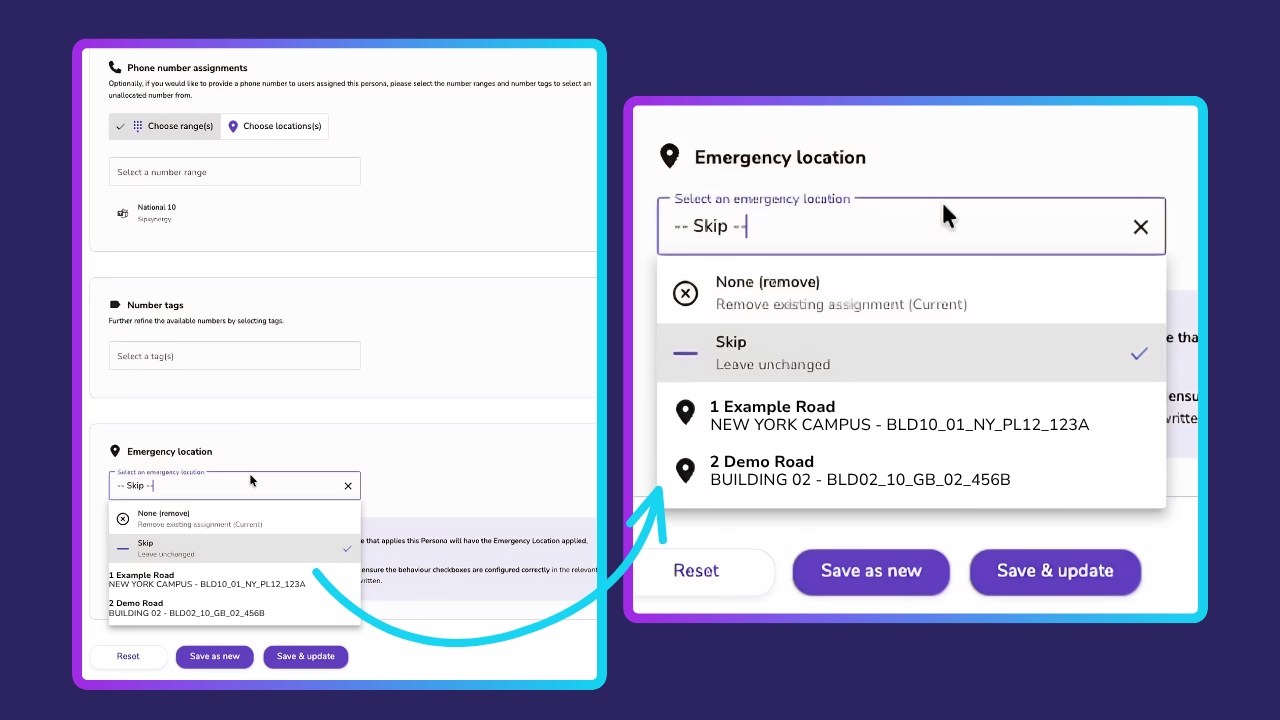
Callroute’s Enhanced Emergency Services Information feature addresses that directly. Callroute now surfaces the specific location attributes synchronized from Microsoft Teams that matter for compliance and troubleshooting, within the same portal administrators use for number management, user provisioning, and carrier connectivity. The attributes now visible include:
- Location ID: the unique identifier Teams assigns to each emergency location, enabling direct cross-referencing against LIS entries
- Validation Status: whether the address has been confirmed against Microsoft’s mapping database, making it immediately clear which locations need attention
- ELIN: the Emergency Location Identification Number, allowing administrators to verify ELIN values match the SBC configuration without a separate workflow
- Latitude and Longitude: the geo-coordinates for each location, so teams can identify entries where coordinates are absent or fall outside the expected area
- State / Province: the state or province field, useful for catching data errors introduced during site migrations or tenant consolidations
For an IT team with compliance obligations across the US, UK, and EU, having these attributes visible and auditable in a single management layer changes emergency location management from a reactive audit task into a continuous part of how the voice environment is run.
Frequently Asked Questions
The Real Measure of Emergency Calling Compliance
Most enterprise Teams deployments will pass a basic compliance audit. Emergency calling is configured. Policies are in place. Direct 911 dialing works. That is the starting point, not the finish line.
The real measure is whether the location data that accompanies a 911 call from your fourteenth-floor conference room, your satellite office in another state, or your remote worker dialing in from a different city is accurate enough to direct a first responder to the right place. That depends not on the initial configuration but on everything that happens to your network, your locations, and your workforce after go-live.
As the share of enterprise voice traffic running over internet-based infrastructure continues to grow, accelerated by the UK PSTN switch-off and the EU’s transition to Next Generation 112, the operational importance of getting this right only increases. The organizations that treat emergency calling as a continuous discipline, not a deployment task, will be better positioned for both the regulatory environment and the infrastructure changes ahead.
Callroute’s Enhanced Emergency Services Information brings the visibility needed to run that discipline from within your existing voice management workflow, surfacing validation status, ELINs, geo-coordinates, and Location IDs directly in the portal alongside number management and automated provisioning.
Emergency Calling Compliance
Staying compliant should not require a separate tool, a separate audit, or a PowerShell session. It should be part of how you manage voice.
If you want to see how Callroute supports emergency calling compliance for enterprise Teams deployments, we would be happy to walk you through it.