As a small business, it’s easy to get bogged down in the hurrah of Microsoft Teams and feel like there are no Direct Routing options tailored to the way you operate.
Microsoft introduced its Calling Plan product to alleviate the potential complexities of using Teams Phone as your PBX if you’re a small business with minimal phone requirements. But it’s not always the case the telephony setups are straightforward.
In this guide, we’re going to introduce Direct Routing for small businesses, highlight the challenges, and run through what you must look for when considering a partner.
- What is Microsoft Teams Direct Routing?
- Why do small businesses need Teams Direct Routing?
- Challenges faced when selecting a Direct Routing partner
- Shortlist of Direct Routing partners for small businesses
- Why Callroute is best suited for small businesses
What is Microsoft Teams Direct Routing?
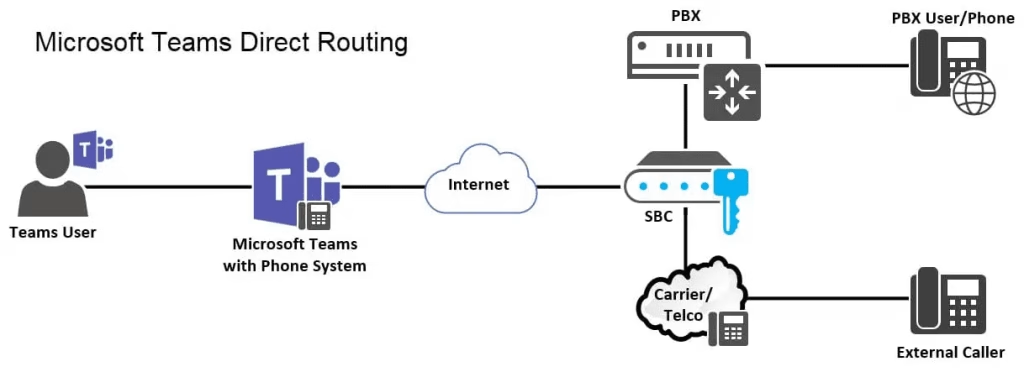
Microsoft Teams Direct Routing is when Microsoft supports connecting session border controllers (SBCs) to Teams. This could either be your own SBC or a vendor’s environment.
The physical or virtual SBC connects telephony (on-premises or virtual) on one side to the cloud (Teams). There’s no certification for vendors or end customers to become ready-to-use for Teams. Only the physical equipment can be Teams-certified.
When you opt for Direct Routing, you get Teams access to unique functionality that an SBC enables. This includes traditional PBX features that you can’t (yet, at least) replicate on a Microsoft Calling Plan deployment.
Direct Routing features
As well as enabling basic PSTN access, businesses often choose Direct Routing because of its extended feature set, compared to using Microsoft’s retail product, Calling Plan.
With Direct Routing, you can enable:
- PBX interop
- Least cost routing
- Media bypass
- SIP trunks
- Analog devices
- Fax
- ISDN connectivity
- Local site breakout
- Survival branch appliance
- Complex routing
- Extension support
- Disaster recovery
How to enable Direct Routing
You need a Microsoft Phone System license to enable Direct Routing.
Phone System is included in Microsoft 365 E5 but must be purchased as an add-on with others. You will also need to purchase Microsoft Teams Enterprise on top of any Office 365 F1, F3, E1, E3 and E5 license to allow users to use Teams.
However, with Direct Routing, this is simply a prerequisite license, rather than the central control tool that it becomes with Microsoft Calling plan.
Once you’ve sorted your licensing, you have two routes to choose from:
| Feature | Self-hosted Direct Routing | Direct Routing as a service (DRaaS) |
| Infrastructure | Requires on-premises or cloud-hosted SBCs | Fully managed SBCs in the cloud |
| Management | Managed in-house or by a specialist third party | Managed by service provider |
| Scalability | Requires manual config when scaling | Easy to scale with vendor support |
| Maintenance & updates | IT team handles patches, updates, etc. | Provider handles all patches, updates, etc. |
| Cost structure | High upfront costs for hardware, licensing, setup, etc. | Subscription-based with no/low upfront costs |
| Time to deploy | Longer deployment due to complex setup | Quick deployment with pre-configured Microsoft-certified SBCs |
| Resilience and redundancy | Must be designed and managed in-house | Usually includes built-in resilience and redundancy |
| Customisation | Full control | Limited customisation, based on vendor offering |
| Compliance & security | Requires in-house security policies and compliance management | Provider looks after all compliance and security |
| Ideal for | Large enterprises with specific IT and Microsoft expertise | Small businesses looking for a fully-managed solution |
Why do small businesses need Teams Direct Routing?
While the Microsoft commentary suggests that everything a small business needs from Teams Phone is catered to in Calling Plan, there are many exceptions.
If you make or receive high call volumes, have an existing PBX you wish to piggyback features, or use SIP trunks with a discounted call bundle, it pays to go down the Direct Routing route (no pun intended). If you’re operating outside of Microsoft’s supported regions, you may have no choice.
When opting for Direct Routing as a small business, you get all the functionality seen in large enterprises – just on a smaller scale.
The benefits of Microsoft Teams Direct Routing are:
- Makes it possible to achieve feature parity with your previous phone system
- Provides a consistent user experience as there’s no third-party calling app
- Removes costs for hardware, software, and maintenance
- Covers regions outside of Microsoft Calling Plan
- Allows users to make calls directly from Teams
- Enables integration with line of business apps
- Lets you keep your existing phone numbers
- Scales easily by adding and deleting users
- Enables complex routing setups
Direct Routing vs Microsoft Calling Plan for small businesses
When weighing up whether Direct Routing is right for your small business, it’s important to understand the gaps in the most obvious alternative.
Here are the differences between Direct Routing and Microsoft Calling Plan – specific to small businesses.
| Feature | Direct Routing | Microsoft Calling Plan |
| Setup & flexibility | Requires SBC and third-party carrier setup and management | Microsoft-provided; managed in the Teams Admin Center |
| Cost | Variable costs dictated by carrier fees, hardware, and licenses | Fixed price per user per month plus usage |
| Carrier choice | Large choice of Direct Routing partners | Locked into Microsoft |
| Global coverage | Broader coverage and wide variety of carriers | Limited to Microsoft-supported regions |
| Feature customization | Advanced call routing, integrations, and compliance options | Standard Teams calling features only |
| Support & management | Requires in-house or third-party expertise | Managed by Microsoft; limited support for small businesses without a dedicated support partner |
| Best for | Small businesses with larger goals, flexibility requirements, or global reach. | Small businesses looking for a predictable pricing model, basic features, and simple management |
Challenges faced when selecting a Direct Routing partner
Cost
Let’s not beat around the bush. Your Direct Routing solution must be in line with your budget and a service provider must provide the payment plan you can afford both now and in the future.
Consider these elements when weighing up costs of Direct Routing as a small business:
- Pricing model: Monthly vs annually; upfront costs for installation, setup, and hardware.
- Hidden fees: What’s included in the monthly service charge versus excess call spend and/or extra support and maintenance.
- Comparing value vs Microsoft Calling Plan: How many features of Direct Routing provide extra value versus the baseline feature of Calling Plan? Is there another way to achieve your goals without major uplift?
Call quality and reliability
A non-negotiable when evaluating any technology partner is the quality of service they provide. Here, we’re talking about the physical service rather than the support wrapper (though that’s important too).
Ask questions about these three items as a minimum:
- Call quality: What does the provider do to ensure optimum quality at all times?
- Reliability: What is the guaranteed SLA (usually expressed as 99.99%, etc.) and what happens if that service level isn’t met?
- Redundancy: What is the plan is something goes down/wrong?
Feature set
Other than providing the basic PSTN connectivity to enable external calls, ask questions about the following:
- Number porting: Will you provider help you get ready for porting and manage the process end to end?
- Advanced call routing: Do the routing, call flow, and self-service options support the levels of customer service you wish to provide?
- Value-add services: What supplemental services are available that you can’t get by using Microsoft Calling Plan? (Compliant call recording, advanced analytics, etc.).
Customer support
As a small business, one of the most vital considerations is the level of support you’ll receive from your Direct Routing partner.
- 24/7 support: Make sure support is available during the times you need it. I.e. if you operate 24/7, this becomes a non-negotiable.
- Dedicated account manager: For scale planning, expanding features, and negotiating contracts, do you have someone to form a relationship with or are you getting a new member of staff every time you need something?
- User reviews and case studies: Get a feel of what real customers are saying on sites like
Shortlist of Direct Routing providers for small businesses
While Microsoft doesn’t certify providers of Direct Routing, it does certify the underlying equipment that can be used in deployments.
These include:
Audiocodes
- Mediant 500 SBC
- Mediant 800 SBC
- Mediant 2600 SBC
- Mediant 4000 SBC
- Mediant 1000B SBC
- Mediant 9000 SBC
- Mediant Virtual Edition SBC
- Mediant Cloud Edition SBC
Ribbon
- SBC 5110
- SBC 5210
- SBC 5400
- SBC 7000
- SBC SWe
- SBC SWe Edge (formerly SWe Lite)
- SBC 1000
- SBC 2000
- SBC 8000 (w/SBC SWe Edge)
TE-SYSTEMS
- Anynode
Oracle
- AP 1100
- AP 3900
- AP 4600
- AP 6300
- AP 6350
- VME
- AP 3950
- AP 4900
Avaya
- Avaya Session Border Controller for Enterprise (ASBCE)
Italtel
- NetMatch-S CI
Enghouse Networks
- Enghouse BorderNet
Using this kit is a wide range of Direct Routing partners, each with their own pros, cons, and best suited target markets.
We’ve done the hard work for you here, as there’s a lot to find out and a lot of partners to shortlist.
Where there are question marks left in the table, this indicates the partners didn’t reply or provide sufficient detail.
| Direct Routing Partner | Countries Supported |
| 8×8 | 55+ Countries (Do delve further into how supported these countries are. This list also isn’t Direct Routing specific. Russia is not supported. China requires an interconnect via Hong Kong). |
| Access4 | Australia and New Zealand |
| AIS Business | Thailand |
| Anywhere365 | West Europe, Southeast Asia, Australia East, North Europe, Central US, Central US 2, Germany West-Central |
| Astroline | Colombia, Peru, Brazil, West and East Coast USA, Mexico, Spain, Ireland, Netherlands, Singapore, Sydney Australia |
| AT&T | ?? |
| Atlantech | Washington DC metro area. |
| Aura Group | ?? |
| AVOXI | South Africa, Uganda, Kenya, Botswana, Ghana, Mauritius, Mayotte, Nigeria, Reunion, Tanzania, Morocco, Tunisia, Seychelles, Cote D’Ivoire, Lesotho, Angola, Burkina Faso, Sudan, Egypt, Mozambique, Ethiopia, Cameroon, Zimbabwe, Zambia, Benin, Rwanda, Bahrain, China, Hong Kong, India, Indonesia, Israel, Japan, Malaysia, Saudi Arabia, Singapore, Taiwan, Thailand, United Arab Emirates, Philippines, Vietnam, Cambodia, Macau, Turkey, Brunei Darussalam, Georgia, Kazakhstan, Nepal, Oman, Pakistan, Sri Lanka, Myanmar, Korea, South, Kuwait, Kyrgyzstan, Jordan, Bangladesh, Uzbekistan, Laos, Qatar, Azerbaijan, Mongolia, Armenia, Jamaica, Dominican Republic, Curacao, Trinidad And Tobago, Bahamas, Anguilla, Antigua And Barbuda, Cayman Islands, Grenada, Guadeloupe, Martinique, Montserrat, Saint Kitts And Nevis, Saint Lucia, Saint Pierre And Miquelon, Saint Vincent And The Grenadines, Turks And Caicos Islands, Virgin Islands, British, Dominica, Virgin Islands, U.S., Saint Martin, Cuba, Mexico, Costa Rica, Panama, Guatemala, Honduras, Nicaragua, Belize, El Salvador, Austria, Belgium, Denmark, France, Germany, Hungary, Ireland, Italy, Latvia, Netherlands, Norway, Poland, Portugal, Russian Federation, Spain, Sweden, Switzerland, United Kingdom, Luxembourg, Finland, Estonia, Czech Republic, Romania, Slovenia, Croatia, Cyprus, Slovakia, Bosnia And Herzegovina, Serbia, Ukraine, Greece, Albania, Belarus, Bulgaria, Iceland, Lithuania, Macedonia, Malta, Moldova, Monaco, Liechtenstein, Montenegro, Kosovo, Canada, United States of America, Barbados, Bermuda, Puerto Rico, Australia, New Zealand, Fiji, Papua New Guinea, Guam, Northern Mariana Islands, Argentina, Brazil, Colombia, Peru, Bolivia, Paraguay, Chile, Venezuela, Ecuador, Uruguay, French Guiana |
| Bandwidth | USA |
| BCX | South Africa |
| Beanfield | Canada |
| Bell | Canada |
| BezeQ | Israel |
| Blue Sky UC | Australia, New Zealand, UK, Canada, Mexico, US |
| BT | UK (With global partnerships) |
| Callroute | Global except China, India, Japan |
| Calltower | 70+ (Do delve further into how supported these countries are.) |
| CBTS | USA and Canada |
| Cezeq | Sweden, Norway, Denmark, Finland, Poland, Czech Republic, Lithuania, Spain, UK and Switzerland |
| Cisco | ?? |
| Colt | Austria, Belgium, Denmark, France, Germany, Ireland, Italy, The Netherlands, Portugal, Spain, Sweden, Switzerland, United Kingdom |
| Connect 365 | ?? |
| Convergia | North, Central, and South America |
| Cox Business | USA |
| Dialog Enterprise | Sri Lanka |
| Enreach | ?? |
| Equada | Germany |
| Exponential-e | UK |
| First Technology | South Africa (With global partnerships) |
| Fusion Connect | ?? |
| Gamma | UK, Spain, France, Netherlands, Germany, Belgium |
| Global Connect | Denmark, Norway, Sweden |
| Gradwell | UK |
| HelloTeams | USA, UK, Australia, New Zealand, Singapore |
| Liquid Intelligent Technologies | South Africa, Zimbabwe, Zambia, Uganda, Rwanda, Kenya |
| Intermedia | USA (With global partnerships) |
| LoopUp | Albania, Angola, Argentina, Australia, Austria, Belgium, Bolivia, Brazil, Bulgaria, Cambodia, Canada, Chile, China, Colombia, Costa Rica, Croatia, Cyprus, Czech Republic, Denmark, Dominican Republic, Ecuador, El Salvador, Estonia, Finland, France, Georgia, Germany, Greece, Guadeloupe, Guatemala, Hong Kong, Hungary, Indonesia, Ireland, Israel, Italy, Japan, Kazakhstan, Kenya, Latvia, Lithuania, Luxembourg, Malaysia, Malta, Mexico, Netherlands, New Zealand, Nicaragua, Nigeria, Norway, Panama, Paraguay, Peru, Philippines, Poland, Portugal, Puerto Rico, Romania, Singapore, Slovakia, Slovenia, South Africa, Spain, Sweden, Switzerland, Taiwan, Thailand, Turkey, Uganda, United Kingdom, United States, Uzbekistan, Vietnam |
| Lumen | ?? |
| MetTel | ?? |
| Momentum | Albania, Argentina, Australia, Austria, Belgium, Bosnia And Herzegovina, Brazil, Bulgaria, Canada, Chile, Colombia, Costa Rica, Croatia, Curacao, Cyprus, Czech Republic, Denmark, Dominican Republic, El Salvador, Estonia, Finland, France, French Guiana, Georgia, Germany, Greece, Guatemala, Hong Kong, Hungary, Iceland, Indonesia, Ireland, Israel, Italy, Jamaica, Japan, Kenya, Latvia, Liechtenstein, Lithuania, Luxembourg, Malta, Mauritius, Mexico, Netherlands, New Zealand, North Macedonia, Norway, Panama, Paraguay, Peru, Philippines, Poland, Portugal, Puerto Rico, Romania, Serbia, Singapore, Slovakia, Slovenia, South Africa, Spain, Sweden, Switzerland, Thailand, Turkey, Ukraine, United Kingdom, United States, Venezuela, Vietnam |
| Nasstar | UK |
| Node4 | UK |
| MTN | South Africa |
| Nexmo | ?? |
| NFON | Austria, Belgium, Croatia, France, Germany, Ireland, Italy, Netherlands, Poland, Portugal, Romania, Slovakia, Slovenia, Spain, Switzerland, United Kingdom |
| NWN Carousel | USA |
| NuWave | USA |
| Odido Business | Netherlands |
| OneCloud | ?? |
| One New Zealand | New Zealand |
| Optus | ?? |
| Orange Business Systems | France (With global partnerships) |
| Peerless Networks | ?? |
| Peoplefone | Austria, France, Germany, Lithuania, Poland, Slovakia, Switzerland |
| PingCo | ?? |
| Pure IP | Australia, Austria, Belgium, Brazil, Bulgaria, Canada, Chile, Colombia, Costa Rica, Croatia, Cyprus, Czech Republic, Denmark, Estonia, Finland, France, Germany, Greece, Hong Kong, Hungary, Ireland, Israel, Italy, Japan, Latvia, Lithuania, Luxembourg, Malaysia, Mexico, Netherlands, New Zealand, Norway, Panama, Peru, Poland, Portugal, Puerto Rico, Romania, Singapore, Slovakia, Slovenia, South Africa, South Korea, Spain, Sweden, Switzerland, Turkey, United Kingdom, United States |
| RingCentral | ?? |
| Sinch | ?? |
| Six Degrees | Austria, Belgium, Denmark, France, Germany, Italy, Spain, France, Ireland, Greece, Netherlands, Sweden, Switzerland, Poland, USA, Canada, Singapore, New Zealand, Australia |
| Sunrise | ?? |
| Swisscom | Switzerland |
| Switch Connect | Australia |
| Symbio | ?? |
| Tata | India (With global partnerships) |
| Telefonica Global Solutions | ?? |
| Telekom Deutschland | Germany (With global partnerships) |
| Telenor | Norway |
| Telia | Estonia, Finland, Lithuania, Sweden |
| Telnyx | Albania, Algeria, Angola, Anguilla, Antigua and Barbuda, Argentina, Armenia, Australia, Austria, Bahamas, Bangladesh, Barbados, Belgium, Belize, Benin, Bermuda, Bolivia, Bosnia, Botswana, Brazil, British Virgin Islands, Brunei Darussalam, Bulgaria, Burkina Faso, Myanmar, Cambodia, Cameroon, Canada, Cayman Islands, Chile, China, Colombia, Costa Rica, Croatia, Curaçao, Cyprus, Czech Republic, Denmark, Dominica, Dominican Republic, Ecuador, Egypt, El Salvador, Estonia, Ethiopia, Finland, France, French Guiana, Georgia, Germany, Ghana, Greece, Grenada, Guadeloupe, Guatemala, Honduras, Hong Kong, Hungary, Iceland, Indonesia, Ireland, Israel, Italy, Jamaica, Japan, Jordan, Kazakhstan, Kenya, Kosovo, Kuwait, Kyrgyzstan, Laos, Latvia, Lebanon, Lithuania, Luxembourg, Macao, North Macedonia, Malaysia, Malta, Martinique, Mauritius, Mayotte, Mexico, Moldova, Monaco, Montenegro, Morocco, Nepal, Netherlands, New Zealand, Nicaragua, Nigeria, Norway, Oman, Pakistan, Panama, Papua New Guinea, Paraguay, Peru, Philippines, Poland, Portugal, Puerto Rico, Qatar, Réunion, Romania, Saint Kitts and Nevis, Saint Lucia, Saint Vincent and the Grenadines, Saudi Arabia, Serbia, Seychelles, Singapore, Slovakia, Slovenia, South Africa, Korea, Spain, Sri Lanka, South Sudan, Sweden, Switzerland, Taiwan, Tanzania, Thailand, Trinidad and Tobago, Tunisia, Turkey, Turks and Caicos Islands, Uganda, Ukraine, United Arab Emirates, United Kingdom, United States, Uruguay, Virgin Islands, Uzbekistan, Venezuela, Vietnam, Zimbabwe |
| Telstra | Australia (With global partnerships) |
| TELUS | ?? |
| Thinktel | Canada |
| Twilio | ?? |
| Verizon Business | USA |
| Vodacom | South Africa |
| Vodafone | ?? |
| Vox Telecom | South Africa |
| Voxtelesys | ?? |
| Yorktel | ?? |
| Zoom | ?? |
Why Callroute is best suited for small businesses
Every Direct Routing solution will be unique to the provider and integration.
A lot of Direct Routing solutions are let down by slow integration times—often up to seven days—and inflexible pricing with long-term contracts reminiscent of traditional telephony.
But neither of these problems is inherent to Direct Routing, and finding the right provider can remove them entirely.
With Callroute for Direct Routing, you get:
- Number porting: Keep your existing phone numbers with a fully managed number porting service.
- New numbers: 10m+ numbers available from all around the world.
- On-demand support: 24/7 customer support, migration, and regular maintenance.
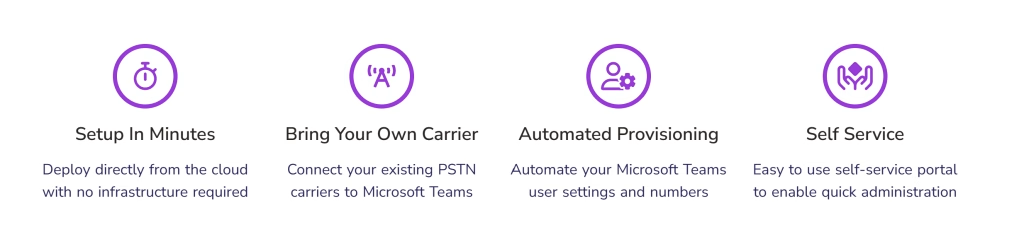
There’s no question that Teams Phone is a great option for small businesses. But the best option for most cases is Direct Routing, which gives you the advantage of sophisticated telephony directly from Teams.
With Callroute, you can harness the power of Direct Routing, unify your phone system, simplify workflows, and future-proof your calling capabilities in a matter of minutes.
To learn more about how Callroute’s Direct Routing, book a free 30-mins demo here.