Last updated March 2026.
If you're supporting thousands of users across multiple council sites, a mix of Microsoft Teams Phone and legacy telephony, plus contact centre and service lines, you're not alone and you're not imagining the complexity.
While this guide focuses on managing Microsoft Teams Phone and hybrid telephony environments today, it is important to recognise that voice services are evolving quickly. The way councils manage telephony now will shape what becomes possible later.
Telephony is no longer just about making and receiving calls. It is becoming part of a wider service delivery layer that connects people, processes, and systems. Over time this will include more automation, better use of data, and selective use of Voice AI to support staff and improve access to services.
For local government, this does not mean rushing into new technology. It means making practical decisions now around governance, standardisation, and control so that future improvements can be introduced safely when the organisation is ready.
If your phone estate is consistent, well owned, and clearly understood, it becomes much easier to introduce enhancements such as intelligent routing, automated triage, or AI assisted call handling without increasing risk. If it is fragmented or poorly documented, even small changes become difficult to manage.
Quick self check. This guide is for you if any of these sound familiar: hybrid telephony, multiple departments, frequent staff moves, shared services, or inconsistent phone number records.
Designing a phone system that's ready for what's next
As the telephony and communications market evolves, councils are being asked to do more with voice services without increasing risk, cost, or operational overhead. Expectations from residents are rising at the same time as budgets and staffing remain constrained.
In practical terms, future improvements in council voice services are likely to include:
- More intelligent call routing based on caller intent rather than simple time based rules
- Automated self service and triage for high volume enquiries
- Stronger links between voice services and core business systems such as CRM, ERP, and knowledge bases
- Voice AI capabilities that support frontline teams by handling routine tasks and gathering information
These developments will not arrive all at once, and they will not replace the need for human service delivery. What they will do is place more pressure on the underlying phone system to be consistent, visible, and well governed.
Councils that already struggle with unclear number ownership, inconsistent call flows, or fragile routing logic will find it much harder to introduce automation of any kind. The barrier is rarely the technology itself. It is the lack of clear structure and control in the existing environment.
Future readiness in telephony is therefore less about choosing specific tools and more about building an estate that is predictable, well documented, and safe to change.
Why good management matters even more in an AI-enabled world
As automation and AI become part of voice services, they will amplify whatever already exists in your environment.
Where call flows are standardised, clearly owned, and well documented, automation can improve responsiveness and reduce pressure on teams. Where they are inconsistent or poorly understood, automation increases the chance of failure and makes incidents harder to diagnose.
In local government environments this matters for more than efficiency. Services linked to safeguarding, emergency response, and out of hours support require clear routing, auditability, and predictable behaviour. Any future use of automation or AI must sit on top of strong operational controls, including:
- Clear service definitions
- Protection for critical numbers and service lines
- Consistent routing patterns
- A strong understanding of how changes affect service delivery
Without these foundations, councils risk creating systems that are difficult to explain, difficult to troubleshoot, and ultimately harder for residents to rely on.
Why government phone system management gets complex
Local government phone systems rarely grow "by design". They grow by necessity.
In most councils, the "phone system" is actually a hybrid estate, meaning a combination of platforms working together:
- Microsoft Teams Phone
- Legacy PBX (traditional phone system still running in buildings)
- SIP trunks (voice connectivity delivered over IP/network)
- Contact centre / service desk lines (often separate platforms for each Citizen Service)
- Emergency, out-of-hours, safeguarding, and on-call lines (mission critical)
- Multiple sites and departments with different needs and risk profiles
- Sometimes even multi-tenant / shared services setups (more than one organisation, IT estate, or Teams environment)
And of top of these, local government has unique pressure points:
1) Multi-site doesn't just mean "more locations"
It means different networks, different buildings, different user needs and expectations, and often legacy contracts and history that can't be easily modernised.
2) High churn isn't just starters and leavers
It's also:
- Restructures
- Service Moves
- TUPE
- Temporary roles
- Seasonal pressures
- Agency staff
- Shared service shifts between councils
All of that impacts numbers, policies, and permissions faster than most telephony systems were ever meant to handle.
3) Shared services and multi-tenant environments multiply admin risk
A tenant is your Microsoft 365/Teams "environment". Some local authorities operate across multiple tenants (or support others who do). That adds complexity like:
- Inconsistent policies and routing rules
- Different governance models
- Difficulty standardising user provisioning
- Troubleshooting that spans organisational boundaries
For more on this topic, you may also find these helpful:
7 common failure points of government phone system management at scale (symptoms + impact)
When a government phone system scales beyond a few hundred users, problems usually show up in predictable ways.
Here are the most common failure points I see in real-world council environments — along with the "why it matters".
1) Number management becomes a spreadsheet problem
Symptoms:
- Multiple spreadsheets across teams
- "Who owns this number?" becomes a support ticket
- Numbers get reused incorrectly after leavers
- Service lines aren't clearly protected
Impact:
Mistakes become public-facing (missed calls, misrouted services) and create reputational risk.
2) Call routing rules are inconsistent across departments
Symptoms:
- Some services route via Teams, others via PBX
- Out-of-hours routing works "for most lines"
- There are different approaches for similar service lines
- Every change becomes custom
Impact:
Your support team can't scale because every ticket becomes investigation work.
3) Support teams can't confidently troubleshoot call failures
Symptoms:
- "Calls are failing" but no one can pinpoint where or why
- Teams shows one thing, PBX shows another
- Suppliers bounce responsibility ("not our side")
- Recurring incidents with no root cause
Impact:
Slow resolution times, repeat incidents, and increased escalations.
4) Moves/adds/changes/deletes (MACDs) are too manual
Symptoms:
- Time-consuming onboarding/offboarding
- Service desk needs specialised telephony knowledge
- Changes require senior engineers
- Queues, auto attendants, and shared lines are "fragile"
Impact:
Delays in enabling frontline staff, reduced productivity, and increased operational cost.
5) Governance is unclear: who approves what?
Symptoms:
- No consistent standards for naming, assignment, or call flow design
- Changes happen "because someone asked"
- No record of who changed routing and when
Impact:
Higher change risk, less accountability, and audit difficulties.
6) Shared service models create duplication and drift
Symptoms:
- Different practices across councils / business units
- Configuration drift between environments
- Inconsistent security and access models
Impact:
Standardisation becomes impossible and you start supporting exceptions forever.
7) Service lines and "mission-critical" numbers aren't protected
Symptoms:
- The same admin approach used for all numbers
- Critical lines get accidentally reassigned
- No clear tiering for priority services
Impact:
High severity incidents: missed safeguarding calls, out-of-hours failures, emergency comms disruption.
What "good" looks like in government phone system management: the operating model + controls for scale
"Good" doesn't mean perfect. It means predictable, supportable, and safe, even during restructures or high-change periods.
Here's my 5 step practical model I recommend to local government IT teams.
1) Treat telephony as a service, not a configuration task
A scaled phone system needs:
- Service ownership
- Documented standards
- Structured change control
- Measurable performance and risk
Think: repeatable patterns, not one-off fixes.
2) Establish "tiered" telephony services
Not every number is equal.
A workable approach is defining tiers like:
- Tier 1: Critical public services
e.g., safeguarding, emergency response, duty lines, out-of-hours escalation
- Tier 2: High-volume service lines
e.g., customer contact centre, housing repairs, waste services
- Tier 3: Standard user calling
e.g., internal calling and individual DDI numbers
This single change improves:
- Prioritisation
- Testing rigor
- Access control
- Incident response
3) Standardise call flow patterns (and don't reinvent the wheel)
Local government often repeats the same patterns:
- "Switchboard to department"
- "Service line with opening hours"
- "Duty team rotation / on-call"
- "Overflow to voicemail or fallback line"
- "Disaster recovery routing"
Document approved patterns and require teams to choose one before custom designs are allowed.
4) Reduce specialist dependency
At scale, you want:
- Service desk to complete safe changes
- Complex changes reserved for specialists
- Clear "guardrails" so frontline support doesn't accidentally break services
This is where structure beats heroics every time.
5) Build visibility + audit into daily operations
As voice services become more intelligent and data-driven, visibility is no longer just an operational requirement — it becomes a strategic one. Understanding how calls are routed, how services behave over time, and how changes impact outcomes is essential for both service improvement and future automation.
At a minimum, you should be able to answer these questions quickly:
- Who owns this number/service line?
- What does it route to today?
- What did it route to last week?
- Who changed it, and why?
- If Teams fails, what's the fallback?
If that takes more than a few minutes, you're operating with hidden risk.
As voice services evolve and become more automated, the same visibility and audit controls will also underpin future enhancements.
Future-readiness
- Call flows are designed so they can be extended with automation or intelligent routing
- Service lines are treated as reusable service assets, not one-off configurations
- Naming conventions and service definitions are clear enough to support both human and automated decision-making
- Governance models would still function if call handling included AI-assisted routing or triage
- Critical services are explicitly protected from uncontrolled experimentation or automation
Checklist for scalable government phone system management
Here's a practical checklist you can use immediately.
Governance & Ownership
- Every service line has an assigned owner (role-based, not person-based)
- There is a clear approvals process for call flow changes
- Critical services are documented and protected (Tiering model)
- There is a standard naming convention for voice objects (queues, auto attendants, resource accounts)
Standardisation
- The council has "approved call flow patterns" for common services
- Shared line setup follows a repeatable template
- On-call and out-of-hours routing is implemented consistently
- Legacy-to-Teams coexistence rules are documented (what stays where, and why)
Change control (MACs)
- Starter/mover/leaver processes include voice changes
- Number assignments are centrally controlled
- Reassignment rules prevent accidental reuse of critical numbers
- Department changes don't require re-engineering call flows from scratch
Support readiness
- Service desk has a troubleshooting guide for common call issues
- Incident tickets include the minimum diagnostic details (line, time, call direction, location)
- Escalation routes are defined (internal + supplier)
- A "known issues" list exists for recurring call problems
Security & access
- Admin access is role-based (least privilege)
- High-risk changes require elevated approval
- Multi-tenant / shared services responsibilities are clearly split
- Audit logging is enabled and reviewed after major changes
Resilience & continuity
- Critical lines have defined fallback routing
- DR (disaster recovery) routing plans exist and are tested
- Opening hours and holiday routing are managed centrally
- Contact centre dependencies are documented (especially for citizen-facing services)
How a management layer supports standardisation and control (without adding complexity)
Once you reach "council scale", the challenge isn't whether Teams Phone works, it's whether it stays manageable across:
- Multiple departments
- Multiple sites
- Shared services models
- Hybrid telephony estates
- Ongoing change
This is where a management layer can help.
Not by replacing Teams Phone, but by improving:
- Standardisation (repeatable deployment patterns)
- Visibility (understanding what's live and where)
- Control (guardrails for safe changes)
- Auditability (knowing what changed and why)
- Operational efficiency (less manual admin, fewer escalations)
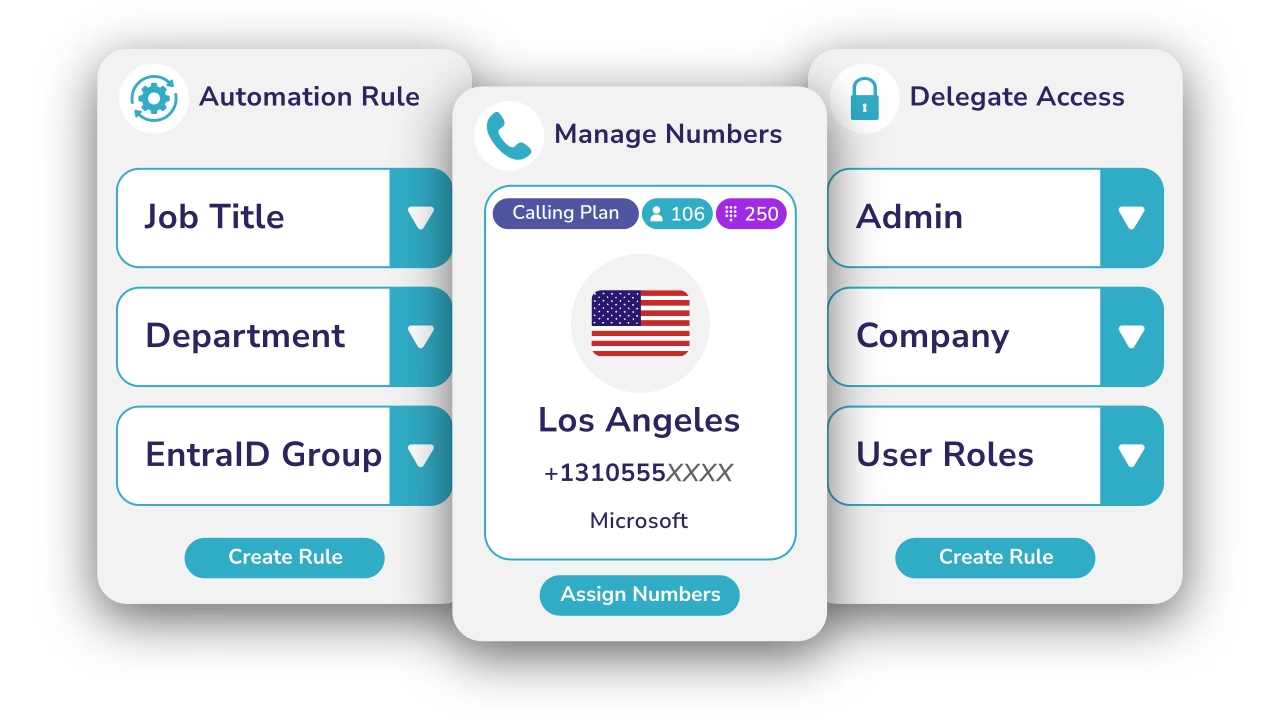
Tools such as Callroute are designed to support this kind of structured management approach – particularly for councils operating at scale across hybrid and multi-tenant environments.
Proof in practice: Local council phone system management at scale
If you want to see how these principles apply in a real local government environment, take a look at our local council case study where we consolidated five Microsoft Teams tenants into a single management layer.
It's a useful reference for what scalable management looks like in practice, especially where Teams Phone, legacy telephony, and service line requirements all need to coexist across multiple Teams tenants.
Further reading: Council Consolidates Management Of 5 Tenants Into A Single Pane Of Glass
Conclusion: scale is achievable with the right controls
Managing a government phone system at scale isn't about doing "more admin".
It's about putting the right foundations in place so your telephony environment becomes:
- Easier to support
- Safer to change
- Consistent across departments
- Resilient for citizen-facing services
Councils that invest now in structure, governance, and visibility are far better positioned to adopt future voice enhancements, including automation and Voice AI, without increasing operational risk or compromising service reliability.
In this way, good telephony management becomes an enabler of innovation, not a barrier to it.
If you're looking to bring more consistency and control to your environment, Callroute can help by providing a practical management layer for Microsoft Teams Phone in complex, hybrid council estates, improving visibility, standardisation, and reducing risk as you scale.
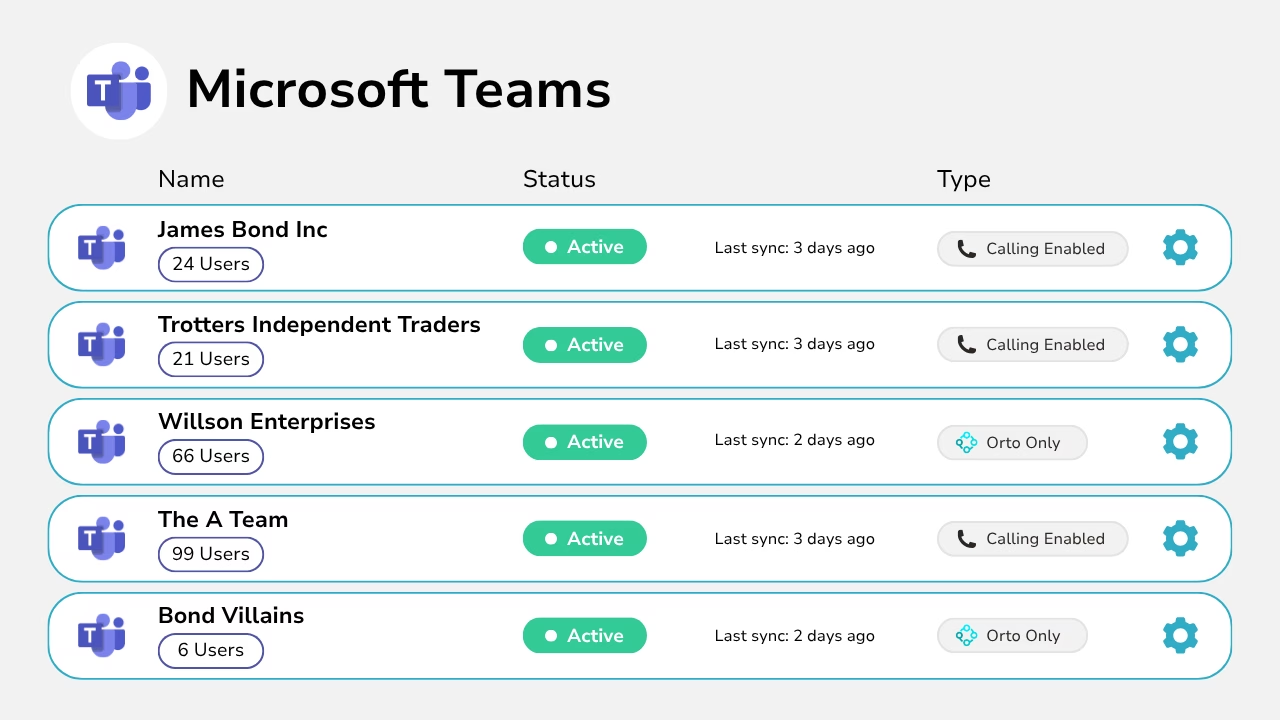
And with our Microsoft Teams user management tools, your team can streamline day-to-day number and service management through structured workflows and clearer ownership, helping local government IT teams spend less time firefighting and more time delivering reliable services for staff and citizens.
Find out more about government phone system management at scale with Callroute here.